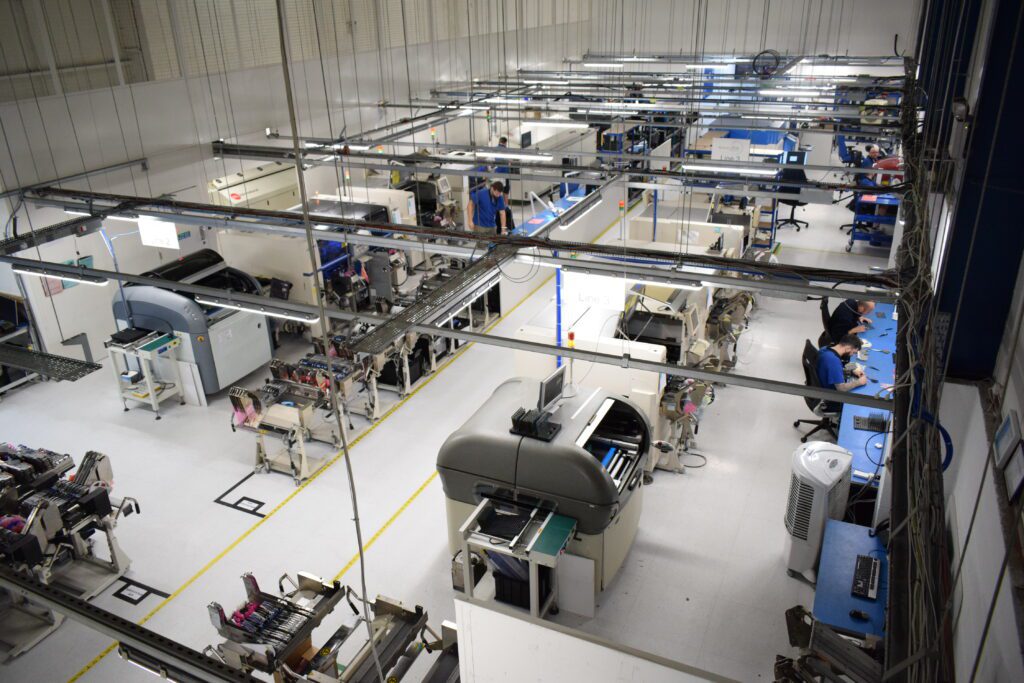
Conformal coating helps protect PCB assemblies from moisture, condensation, dust, chemical exposure and other environmental factors that can affect long-term reliability. At Active-PCB Solutions, conformal coating is carried out within our dedicated Reading facility, where cleaning, selective application, curing, manual coating and inspection are brought together under one roof.
Here’s a closer look at the equipment, processes and materials involved.
Preparing And Cleaning The PCB Assembly
Good conformal coating starts before the coating itself is applied.
Flux residues, processing contaminants and other residues can become trapped beneath the coating if the assembly is not suitably clean beforehand.
Where required, PCB assemblies can therefore be processed through our fully automated four-stage wash system, which includes cleaning, rinse, DI rinse and evaporative drying.
We also monitor ionic residue to help assess whether assemblies are suitably clean before coating. Ionic contamination may not be visible, but conductive residues can contribute to issues such as corrosion or electrical leakage when moisture is present.
Selective Automated Conformal Coating
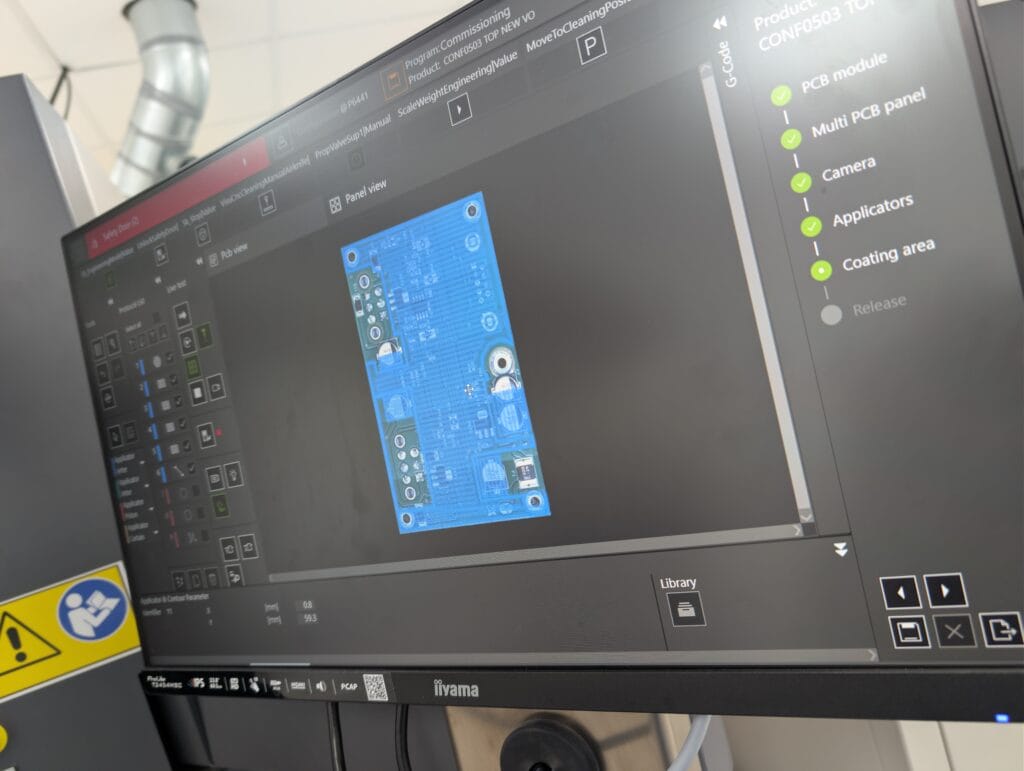
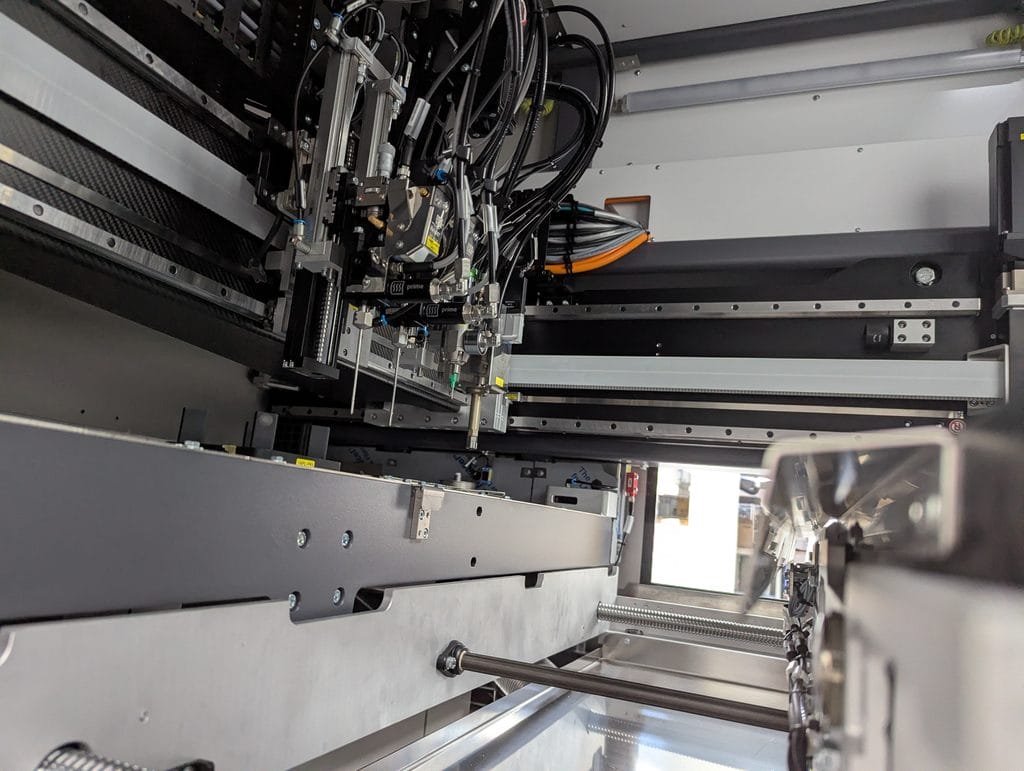
For automated coating, we use a four-headed Rehm Protecto XP selective conformal coating system.
Selective coating allows material to be applied only where it is required, while avoiding areas such as connectors, test points and other sensitive features.
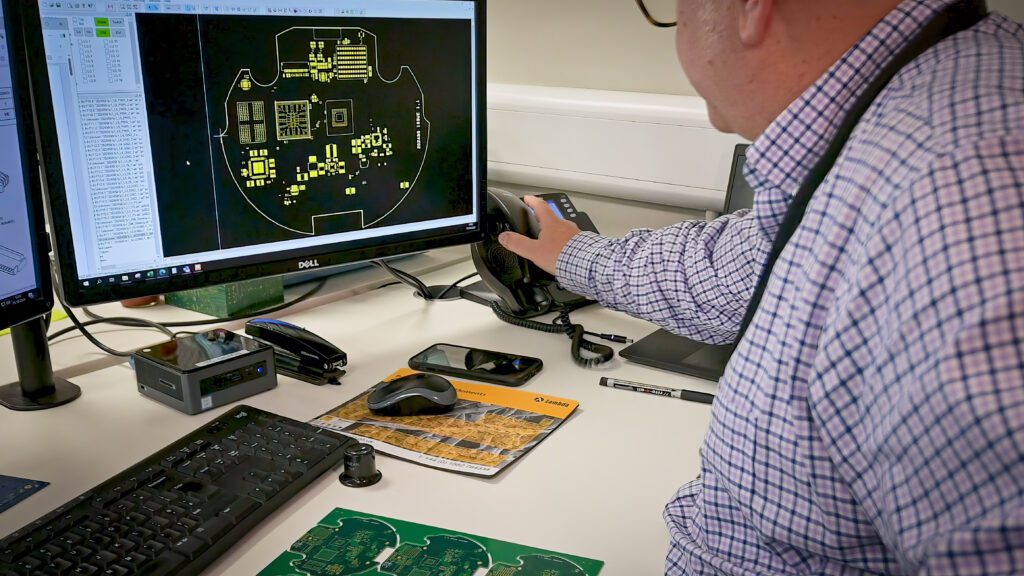
The system is programmable using ODB++ or Gerber data, helping provide repeatability and traceability from one build to the next. Its four-head configuration allows up to four different materials to be available within the process, supporting both complex high-mix assemblies and higher-volume production.
This sits alongside our wider SMT and through-hole PCB assembly capability, allowing coating requirements to be planned as part of the overall production route.
Choosing The Right Conformal Coating Material
There is no single conformal coating material that is right for every PCB assembly. Factors such as the operating environment, required moisture and chemical resistance, mechanical demands and the potential need for future rework can all influence the choice.
Our in-house options include acrylic 1B31, urethane 1A33 and nanocoating.
- Acrylic offers good moisture resistance and dielectric properties, while also being comparatively straightforward to remove if future rework is required.
- Urethane provides stronger chemical and mechanical resistance alongside good protection against moisture and humidity.
- Nanocoating provides an ultra-thin, lightweight option for suitable assemblies and can reduce the need for traditional masking in some applications.
You can read more about choosing the right conformal coating material for PCBs.
Where silicone or parylene is more appropriate, we can also support those processes through trusted specialist partners.
Controlled Curing
Once coating has been applied, assemblies can move into our Vanstron VHB-250 in-line curing oven.
The system uses a 12-module heating configuration with four programmable heating zones and temperatures up to 200°C. It supports both batch and in-line processing, while its vertical buffer provides the equivalent of approximately 40 metres of oven length within a compact footprint.
With capacity for up to 50 pallets simultaneously, the system allows curing conditions to be controlled according to the coating material and production requirement.
Manual Coating For Complex Requirements
Not every PCB assembly is best suited to a fully automated route, prototypes, unusual board geometries, low-volume builds or particularly complex assemblies may require greater flexibility, so our Reading facility also includes semi-automated and manual spray capability.
This gives our production team an alternative where hand application is the more appropriate approach and complements our low-volume, high-mix PCB assembly capability.
UV Inspection And Quality Control
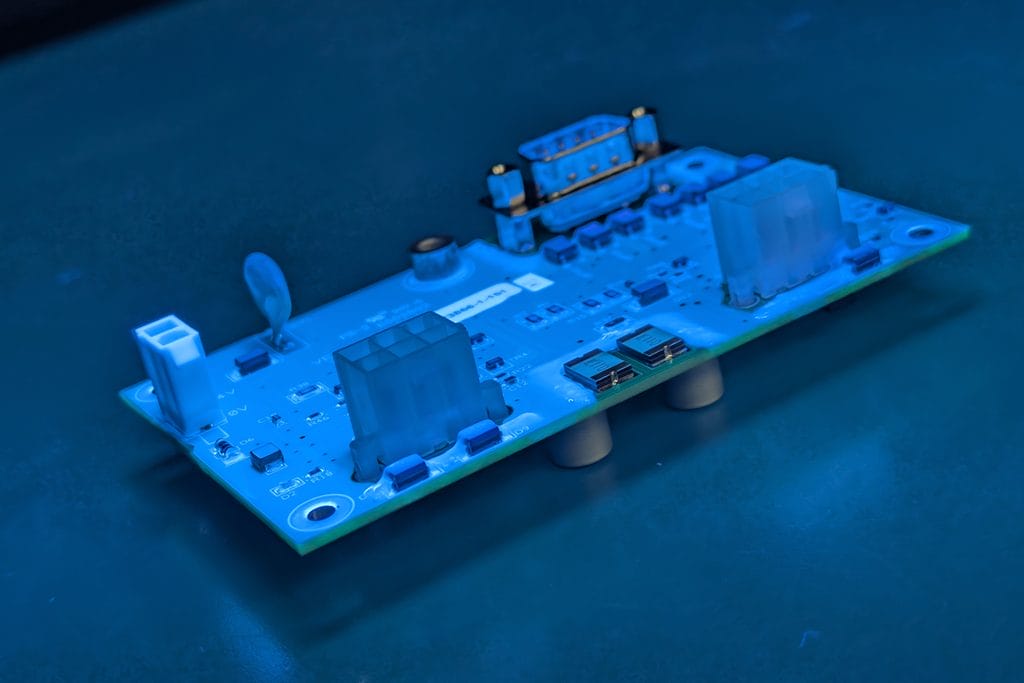
Our facility also includes dedicated UV inspection booths, allowing coated areas to be examined clearly before assemblies move on.
This helps our team to check coating coverage and identify areas requiring further attention as part of the quality process.
Conformal coating inspection sits alongside our broader PCB testing and inspection capabilities, including Automated Optical Inspection, X-ray inspection, flying probe testing and functional testing.
Designing With Conformal Coating In Mind
Conformal coating is often considered towards the end of a project, but discussing it earlier can make the manufacturing process more straightforward.
Connectors, switches, test points and other areas may need to remain coating-free, while component position and spacing can affect the coating strategy.
Considering these requirements during PCB prototyping and NPI gives engineering and production teams the opportunity to review the coating material, masking requirements, application method and curing process before repeat production begins.
Keeping Conformal Coating In-House
Having conformal coating available within our Reading facility means it can be managed alongside PCB assembly, inspection, testing and box build and system integration.
This reduces the need to send assemblies elsewhere for additional processing, helping our production team maintain greater visibility over scheduling, quality and the overall build.
If your current or future PCB assemblies require conformal coating, speak to the Active-PCB Solutions team about the application, operating environment, material requirements and expected production volumes.
The earlier coating requirements are considered, the easier it is to build them into a controlled and repeatable manufacturing process.